Ask your team how many leads came in. You will get three answers
Almost every agency has a CRM. Far fewer have any order inside it. The difference shows up at the first Monday meeting.

Monday morning, team meeting. You ask how many leads came in last week. Three people answer, and all three work in the same CRM.
Three versions of one week
The first counted the cards in the system. The second read from a list in phone notes. The third remembers a WhatsApp thread nobody else has ever seen. And each of them is right in their own way.
The CRM is live, by the way. Licences paid, training done, everyone has access. It is just that some of the data goes in, and some of it stays in a head, a messenger and a notebook.
You end up with an odd arrangement. The tool is there. The control is not.
The price of one question
Every gap costs time. An agent messages a colleague to find out whether the client was called yesterday. The colleague is at a viewing and will reply in two hours. By then the client has written to two other agencies.
A new hire takes a month to get up to speed instead of a week, because they are not learning a system, they are learning the habits of four specific people. You open the weekly report, see half-filled data, and after the second time you stop opening it. The worst part is how quickly all this starts to feel like a normal working pace.
Chaos in a CRM rarely looks like a problem. It looks like an ordinary busy day where everyone is working and the numbers somehow stay where they were.
Where it tears
Take an agency apart at the seams and the break points are usually few.
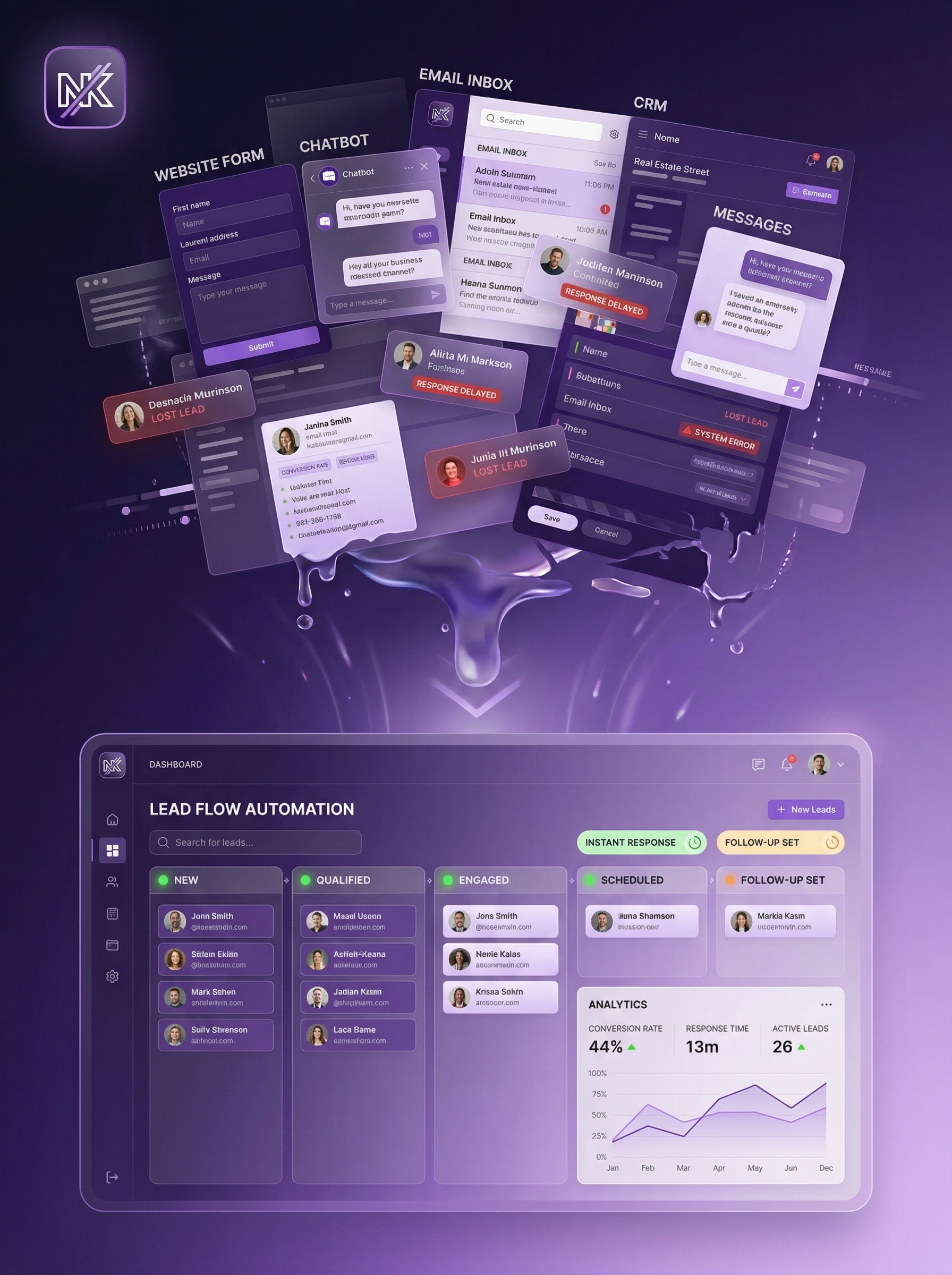
- Leads from ads are entered by hand. Someone has to open the ads account, copy a name and a phone number, create a card.
- A status changes but nothing stands behind it. Warm is a word, not a task with a date and an owner.
- The follow-up after a viewing lives in the agent's memory. There is one memory and four viewings a day.
- The conversation happens in WhatsApp and Instagram, the client history sits in the CRM. Two different places, and they never meet.
Discipline does not fix this. Or rather it does, right up to the first busy week.
Growth fixes nothing
With a dozen leads and two agents, the mess is tolerable. Everything rests on memory, and on the whole memory holds. Triple the leads and triple the people, and the same setup starts dropping deals, and nobody can tell you which ones.
Seconds instead of hours
Automation is not about people trying harder. It is about removing the places where things fall apart.
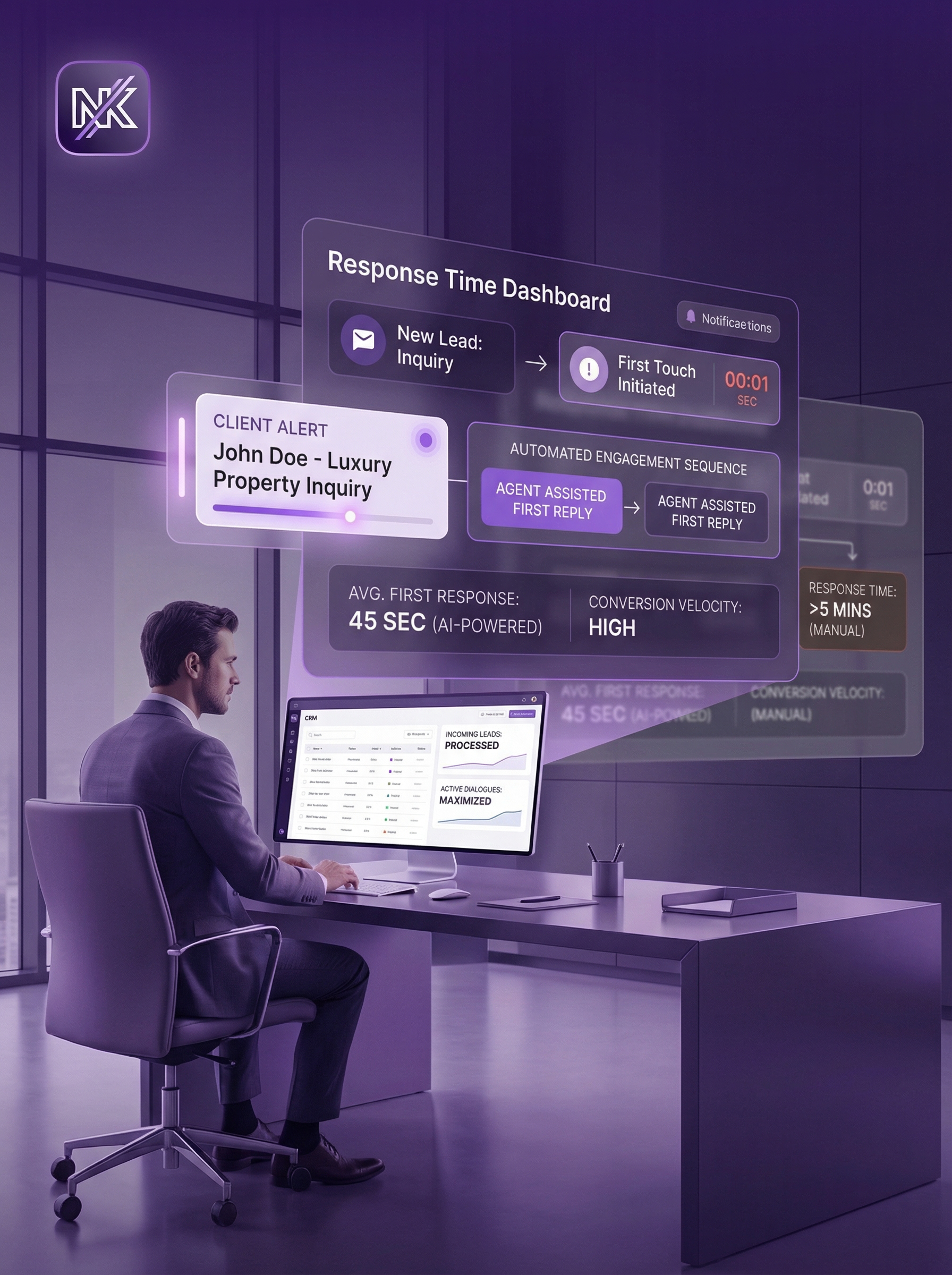
On the IRSIP project in the UK we connected Facebook Lead Ads straight to the CRM. A lead started landing in the system in seconds instead of hours, whenever somebody finally got round to opening the ads account.
After that it is the ordinary mechanics of the CRM module: leads on a kanban board, hot, warm and cold, a client card with history and notes, tasks, reminders, channels and reports in one place. Data stays in the EU, each business isolated from the rest. That is 100 € a month. Put an AI agent next to it, one that answers first and hands the manager a structured lead, and it is 190 € for both modules.
The inconvenient part
The honest answer is that a CRM on its own fixes nothing. It will not turn a weak agent into a strong one, and it will not make someone pick up the phone who would rather not. Order in the data only shows what is actually happening, and the picture is not always a pleasant one.
One more condition, and not everybody likes it. We connect the modules only to our own site: 390 € and seven days to launch. That is a studio condition, and it stays the same on every project.
Order is not about pretty reports. It is when the question of how many leads came in last week has one answer. And you do not have to check it with anyone.
A kanban of leads, a client card with full history, tasks and reports on how fast each manager responds. Data stays in the EU.
We do not build “one more website”. We put AI into how a business runs: leads are not lost, routine goes to automation, numbers grow.
Discuss a project